Feast of the Dedication of the Basilica of St. Francis Scripture Readings
Saint Francis of Assisi was an Italian Catholic friar and deacon who founded the men'south Order of Friars Small (the Franciscans), the women's Order of St. Clare (The Poor Clares), and the Third Order of St Francis. He was born, and given the proper noun Giovanni di Pietro di Bernardone, in 1181 or 1182 Advertising in Assisi, Perugia, Umbria, Italia and died on October 3 1226 in Assisi, Umbria, Italy at the age of 44. We celebrate his banquet day on October 4 every year in the Catholic Church.
| Saint Francis of Assisi Biography | |
|---|---|
| | |
| Engagement of Nascence | 1181 or 1182 Advert |
| Place of Birth | Assisi, Perugia, Umbria, Italy |
| Profession | Italian Roman Cosmic friar, deacon and founder of the men's Order of Friars Minor (the Franciscans), the women's Guild of St. Clare (The Poor Clares), and the 3rd Order of St Francis |
| Place of Work | Assisi, Italy |
| Engagement of Decease | October three 1226 (aged 44 years) |
| Place of Expiry | Assisi, Perugia, Umbria, Italy |
| St. Francis of Assisi Feast Day | October 4 |
| Canonization | Past Pope Gregory 9 on July 16 1228 in Assisi, Italia |
| Patron Saint of | 1. Animals two. The environment 3. Italy 4. Merchants v. Stowaways half dozen. Cub Scouts seven. San Francisco, California 8. Ecology |

St Francis of Assisi Life History
St Francis of Assisi'southward begetter was called Pietro di Bernardone dei Moriconi, a successful fine wearing apparel, and silk merchant. His mother was chosen Pica de Bourlemont. When Francis was born in Assisi, his father had gone to France on business. His mother baptized him every bit Giovanni (John) but when his begetter arrived from France, he began calling him Francesco, which means 'the Free human being'. This was considering Pietro loved France and what the country had washed for his commercial success.
St Francis's family was well-to-do and they lived just like the typical wealthy families did. Francis was very handsome, witty, brave, very fond of troubadour (composer and performer of Quondam Occitan lyric poetry), and loved fine dress.
In 1202, when he was effectually twenty years, Francis joined a military expedition in Assisi militia in a battle against the neighboring city of Perugia. During the war, Francis was captured and taken equally a prisoner for almost a year before his ransom was paid. Later this, Francis started reflecting on his life but still went back to his carefree life.
In 1205, during another military expedition, he prematurely left the state of war and returned to Assisi when, in a vision, he heard a voice telling him, "Follow the master rather than the man". From this time, he spent nearly of his time privately and in prayers.
He lost interest in worldly life and also avoided accompanying his friends to sports, feasts, and parties. A friend noticed this and asked him whether he was thinking of marrying, and he answered, "Yeah, to a fairer bride that none of you have ever seen". He meant he was marrying his poverty.
Francis started becoming disillusioned by the spoils of this earth when he was still immature. 1 incident happened when he was sent by his father to sell wearing apparel and velvet. As he went about his business, a beggar approached him and begged for money. When he was done selling his merchandise he came back to the ragamuffin and gave him all the money he had made. This infuriated his father a lot and his friends could not understand that level of clemency.
From that day, Francis started making frequent charitable visits to Churches, hospitals, and leper houses. At one fourth dimension, Francis went on pilgrimage to Rome to seek spiritual fulfillment and began begging at St. Peter'southward Basilica. While praying, Francis had a vision of Jesus Christ in the chapel of San Damiano saying to him, "Francis, go and repair My firm which, equally you lot can see, is falling into ruins." He returned to Assisi, went to the family unit store, took and sold wearing apparel worth a lot of money. He also sold his father's horse and donated everything to the church of San Damiano without his male parent's permission. His father was very angry about it for he said that was theft.
Francis ran away and hid in a cave almost San Damiano for about a month only later on much suffering and hunger, he returned habitation. His father beat him thoroughly and locked him in a room, however, his mother released him.
Francis sought shelter with the priest at San Damiano only his father soon caught up with him and instituted a legal proceeding to strength Francis to return the money and likewise forego his inheritance. Francis, returned the coin but, however, he removed his clothing, piece by piece until he was naked before everyone. Bishop Guido of Assisi, who was among those present at the proceeding covered him with his own cloak. He renounced his father and his patrimony and was left destitute and disinherited.
He spent several months begging effectually for food and stones in the town of Assisi. He carried those stones to the Chapel of San Damiano where he rebuilt it over a period of two years. He also helped rebuild the San Pietro Chapel in Spina and the Chapel of St. Mary of the Angels.
I morning in February 1208, during Mass in the chapel of St. Mary of the Angels, Francis was greatly inspired by the day's gospel about the "Commissioning of the Twelve". He was carried away past the message that, "become and proclaim that the Kingdom of God is at hand". He went around the countryside preaching to the people about penance, peace, and brotherly dearest.
Within 1 year, Francis had eleven followers. They lived a very simple and austere life and continued to preach to the people through their words, actions and lifestyle.
St Francis, in 1209, composed a simple rule for his followers called the Regula Primitiva (Primitive Dominion). The rule was "To follow the teachings of our Lord Jesus Christ and to walk in his footsteps".
Together with his starting time eleven followers, Francis went to Rome to seek permission to found a new religious guild from Pope Innocent 3. They found Bishop Guido of Assisi and Giovanni di San Paolo, the Central Bishop of Sabina.
The central heard Francis and entourage had to nowadays and bundled for them to meet Pope Innocent Iii. The pope agreed to informally admit the group until they commanded a larger number when they would return to Rome for official admittance. The twelve were tonsured.
On April 16 1210, the Society of Friars Small-scale likewise known equally the Franciscan Order or the Seraphic Club was officially founded. They began preaching in Umbria and so to the remainder of Italia. After Francis was ordained a deacon he chose not to exist ordained a priest.
The Poor Clares
In 1211, after Francis preached in the church of San Rufino in Assisi a young woman, Clare of Assisi was inspired and wanted to alive like Francis. She secretly left home and joined Francis and established the Order of Poor Ladies.
Francis housed them at San Damiano in a few small huts or cells and the place became the get-go monastery of the Poor Clares, Second Franciscan Order.
The Tertiary Order
To cater for those who could non manage o leave home, Francis formed the Tertiary Order of Brothers and Sisters of Penance, (the Secular Franciscan Gild). This group was composed of the laity who observed the principles of Franciscan life in their daily lives.
St Francis willed to preach the Gospel all over the world and therefore planned to travel out of Italian republic.
In 1212, he planned to travel to Jerusalem, only a storm cut curt his journeying on the Dalmatian coast, and returned to Italian republic.
In 1213, Francis planned to go to Morocco but while in Kingdom of spain he cruel ill and terminated his journeying.
In 1219, Francis and another friar hoped to convert the Sultan of Egypt. They went to Egypt at a time when at that place was a ceasefire of war betwixt the Muslims and Christians. The sultan received them graciously and Francis preached to the Muslims. They returned to Assisi unharmed. From this time, the Franciscans were allowed to stay in the Holy Land and were recognized as "Custodians of the Holy Land" on behalf of the Catholic Church.
The Franciscan Order grew rapidly compared to other Orders and therefore Francis wrote a more than detailed rule "Rule Without a Papal Balderdash" which reinforced the devotion to poverty and the apostolic life. He wrote the "Second Dominion" or "Rule With a Bull" which on November 29 1223 was approved by Pope Honorius III. This dominion called upon the friars to observe the Holy Gospel of our Lord Jesus Christ, living in obedience, chastity and without annihilation of our own."
St Francis had a great love for animals and the surround. He preached that God created the world good and beautiful simply human sins make it suffer and therefore it needs redemption. Francis thanks God for Blood brother Dominicus, Sis Moon, Blood brother Wind, Water, Fire, and Earth.
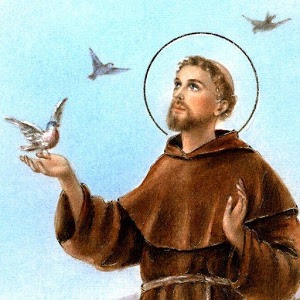
One day while Francis was traveling with some companions, they came to a place where were trees on both sides of the road filled with birds. He told his companions to wait as he preached to "my sisters the birds." Fascinated by his vocalisation, many birds surrounded him and none flew away. This is why in art, he is portrayed with birds in his hands.
There is a legend that says there was a wolf that terrorized the animals and people in the Metropolis of Gubbio. St Francis went to the mountains and when he found the wolf he made the sign of the cross and implored the wolf to injure no one else. He went around the streets of Gubbio and made a pact between the residents and the wolf. He said that because the wolf preyed upon the urban center because of hunger, the residents should feed it regularly and the wolf would stop devouring the residents and their animals. The menace stopped.
On September 13 1224, St Francis had a vision before the Feast of the Exaltation of the Cross and he received the stigmata. Brother Leo, who was accompanying Francis says that "All of a sudden he saw a vision of a seraph, a half-dozen-winged angel on a cross. This angel gave him the gift of the v wounds of Christ."
Saint Francis of Assisi Expiry
Francis started to endure from these stigmata and trachoma and unsuccessfully sought treatment in dissimilar cities. Finally, he was brought back to his hut where he spent the residue of his fourth dimension dictating his spiritual testament. Francis died on Oct 3 1226, Saturday evening singing Voce mea advertisement Dominum (My Voice to the Lord) in Psalm 141, "Prayer for Deliverance from the Wicked".
Canonization
Pope Gregory IX canonized Saint Francis of Assisi on July 16 1228.
Relics
Later the Basilica of St. Francis in Assisi was synthetic, the torso of Francis was buried under the Lower Basilica on May 25 1230. Blood brother Elias ordered that this tomb be hidden to protect it from invading Muslims. This tomb was rediscovered in 1818.
Saint Francis of Assisi Feast Day
The banquet twenty-four hours of Saint Francis of Assisi is historic on October 4 every year in the Cosmic Church. During the banquet, information technology is pop for people to bring their pets and other animals to church for approving.
Saint Francis of Assisi is the Patron Saint of
Because of St Francis' beloved for the fauna and flora, Pope John Paul 2, on Nov 29 1979 declared St Francis the patron saint of ecology.
- The Franciscan Club
- Tapestry workers
- Stowaways
- Peace
- Needleworkers
- Merchants
- Many Catholic Dioceses
- Families
- Ecology
- Cub Scouts
- Catholic Action
- Animals
- Santa Fe, New United mexican states
- San Pawl il-Bahar, Republic of malta
- San Francisco, California
- San Francisco de Malabon, Philippines
- Salina, Kansas
- Quibdó, Colombia
- Naga City, Cebu, Philippines
- Metuchen, New Jersey
- Lancaster, England
- Kottapuram, India
- Italy
- Freising, Frg
- Colorado
The Complete List of Writings of St Francis
Rules, Testament and Admonitions
- Attestation (1226)
- Dominion for Hermitages
- Regula not bullata, (1221)
- Regula bullata, (1223)
- Last Volition written for Saint Clare
- Form of Life given to Saint Clare
- Admonitions
Letters
- Second version of the Letter of the alphabet to the Faithful, (Epistula advertising Fideles Two)
- Second Letter to the Custodians, (Epistula advert Custodes 2)
- Letter to the Rulers of the Peoples, (Epistula advert populorum rectores)
- Letter to the entire Club, (Epistula toti Ordini missa)
- Letter to the Clergy, (Epistula ad Clericos)
- Letter to Brother Leo, (Epistula ad fratrem Leonem)
- Letter to Brother Anthony, (Epistula ad fratrem Antonium)
- Letter to a Minister, (Epistula ad Ministrum)
- Offset version of the Letter to the Faithful, (Epistula ad Fideles I)
- Start Letter to the Custodians, (Epistula ad Custodes I)
Prayers
- Salutation to the Blessed Virgin Mary, (Salutatio Beatae Mariae Virginis)
- Salutation of the Virtues, (Salutatio Virtutum)
- Prayer inspired past the Our Father, (Expositio in Pater Noster)
- Prayer before the Crucifix, (Oratio ante crucifixum dicta)
- Praises to be said at all the Hours, (Laudes ad omnes horas dicendae)
- Parchment given to Blood brother Leo, (Chartula fratris Leonis information)
- Role of the Passion, (Officium Passionis Domini)
- Exhortation to the Praise of God, (Exhortatio ad laudem Dei)
- Canticle of Blood brother Lord's day, (Canticum Fratris Solis)
Dictated Writings
- True and Perfect Joy, (De vera et perfecta laetitia)
- Attestation written in Siena
- Alphabetic character written to Lady Jacopa
- Alphabetic character written for the citizens of Bologna
- Letter sent to the Brothers in French republic
- Approving sent to Saint Clare and her Sisters
- Blessing given to Blood brother Bernard
Peace Prayer of Saint Francis of Assisi
Lord, brand me an instrument of your peace:
Saint Francis of Assisi
where there is hatred, let me sow love;
where there is injury, pardon;
where there is doubt, faith;
where there is despair, hope;
where there is darkness, calorie-free;
where there is sadness, joy.
O divine Principal, grant that I may not then much seek
to exist consoled every bit to console,
to be understood as to understand,
to be loved as to love.
For it is in giving that we receive,
information technology is in pardoning that nosotros are pardoned,
and it is in dying that we are built-in to eternal life.
Amen.
Powered By SEO Experts
Source: https://catholicreadings.org/saint-francis-of-assisi/
0 Response to "Feast of the Dedication of the Basilica of St. Francis Scripture Readings"
Post a Comment