Jeanneclaude Denat De Guillebon Its Only a Work of Art
Articles and Features
Subtracting Reality, Revealing Beauty. A Tribute To The Unique Legacy of Christo and Jeanne-Claude
Past Benedetta Ricci
"I call up it takes much greater courage to create things to be gone than to create things that will remain".
Christo
Who are Christo and Jeanne-Claude?
If you happen to visit Paris, you lot might desire to stop by Rue Visconti. Connecting Rue Bonaparte and Rue de Seine, it is one of the narrowest streets in the city and, since the sixteenth century, has been home to many prestigious tenants, including Racine, Delacroix, and Balzac. However, the fame of this piffling street famous was premised not on its illustrious inhabitants nor its celebrated boutiques, merely instead an effect of June 27th, 1962. It was 9 pm when, in front of a small dumbfounded crowd, a truck entered the street, stopped and unloaded 89 metallic barrels used for transporting gasoline and oil. What at first glance could be mistaken for a public works crew at this unusual time of day was actually the first large-scale piece of work by a couple of artists that would literally come to spread their vision over much of the world.
The barrels, non contradistinct in any way from their original industrial appearance – colours, brand names, and rust were nonetheless visible – were arranged to course an impassable, iv-meters-loftier barricade that blocked the street for eight hours. The artwork, titled Wall of Oil Barrels – The Fe Curtain, temporarily transformed the perception of Rue Visconti turning it into a dead-cease street: a simple activeness full of implications past which the artists, Christo Vladimirov Javacheff and Jeanne-Claude Denat de Guillebon – at the time working merely nether the proper noun "Christo" – manifested their protest against the contempo construction of the Berlin Wall.
The previous year, the creative duo had applied to the municipality of Paris for permission to create the work, a request that had been denied; therefore Wall of Oil Barrels – The Fe Curtain proved to be a foretaste non simply in terms of their arroyo to urban intervention and medium – cans and barrels will exist recurrent in Christo and Jeanne-Claude'south piece of work – but besides in terms of their infrequent tenacity in realising their projects.
Final week, Christo passed abroad in his home in New York Metropolis at the historic period of 84, having outlived his life and piece of work partner, Jeanne-Claude, by eleven years. His studio stated: "Christo lived his life to the fullest, non merely dreaming up what seemed impossible merely realizing information technology. Christo and Jeanne-Claude's artwork brought people together in shared experiences beyond the globe, and their work lives on in our hearts and memories".
Their extraordinarily influential work reshaped and exalted reality by removing obviousness and addiction from the world's eyes, permanently changing our perception of urban and natural surroundings, influencing the parameters of art, sculpture, installation, land and environmental art, and expanding the very definition of contemporary art itself.
"We want to create works of art of joy and beauty, which we will build because we believe it will exist beautiful".
Jeanne-Claude
Biography of Christo
Christo was born in Gabrovo, Bulgaria, in 1935 and grew upwards amid the wreckage caused first by the Commencement Balkan State of war, then by the carnage of World War 2. He was educated under the repression of the postwar communist government, choosing at the age of 21 to pack up his things, and to make this manner westwards via Prague, then Vienna, Geneva and, by 1958, in Paris. With no money, no connections and not a discussion of French, Christo began to do every kind of job imaginable to earn a living--repairing cars, washing dishes in restaurants, conveying crates of tomatoes and, nearly of all, painting portraits which he signed by his family name: Javacheff. On one occasion he was deputed to portrait the wife of General de Guillebon, Précilda: she was Jeanne-Claude'south mother. Born on the verbal aforementioned day, the 13th of June, 1935, Jeanne-Claude and Christo fell in dearest, and in no time were married.
Story of an iconic duo: Christo and Jeanne-Claude
Christo and Jeanne-Claude's enduring artistic collaboration was also to brainstorm, and the couple seemed to have a clear and determined plan; in a 1958 letter, Christo wrote: "Beauty, science, and art will always triumph".
Whist at the fourth dimension it was their purpose and strategy, today it forms the boulder of their legacy.
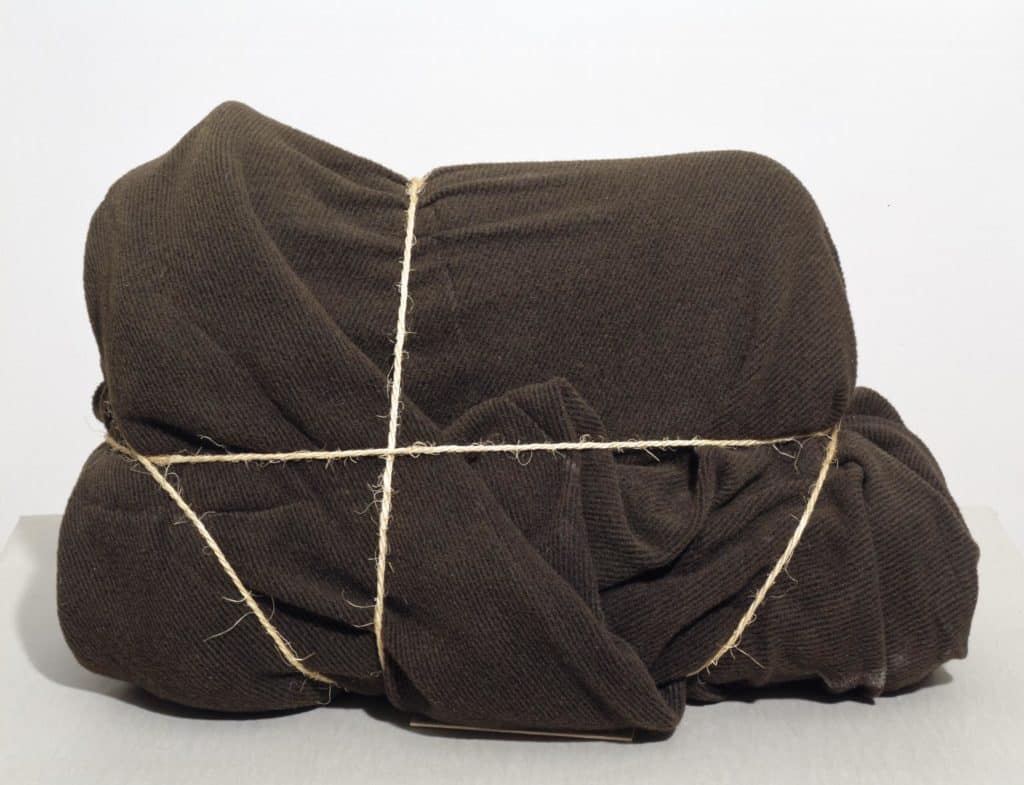
They began with wrapping objects, minor everyday items such as bottles and cans packed in material or synthetic materials and twine, largely inspired by the piece of work of Joseph Beuys and Man Ray, especially Fifty'Enigme d'Isidore Ducasse. The idea backside the wrapping was that the darkening encourages the viewer to look with renewed marvel to the object beneath and the space in which it exists, whilst also calculation new sculptural qualities to ordinary shapes.
Afterward Wall of Oil Barrels – The Fe Curtain, the duo officially stepped into the art world.
In 1964, they moved to New York bringing the intent and act of wrapping to a much vaster calibration, applying information technology to both natural and man-made environments and refining a technique that was to get a signature and artistic trademark.
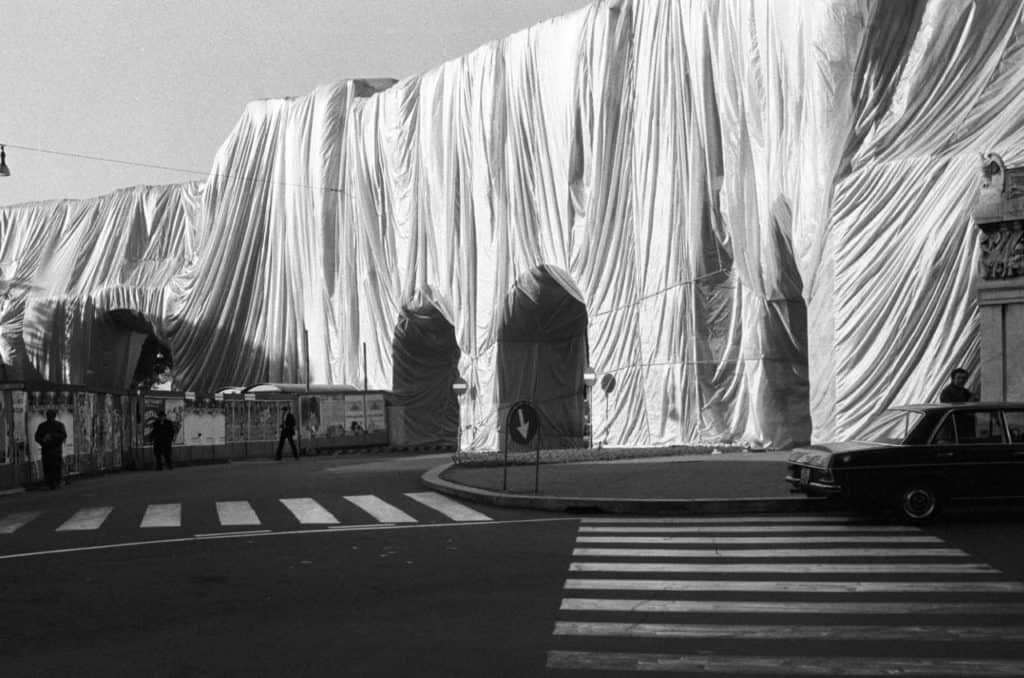
They started in 1968, outset wrapping a fountain and a medieval tower in Spoleto, Italia, followed past the Kunsthalle in Bern, and moving onto the Museum of Gimmicky Art in Chicago, with this early period culminating in wrapping a ane-million-square-feet portion of coastline in Footling Bay, Sydney. These endeavours were followed by two historical monuments in Milan, role of the Aurelian Wall in Rome and, among their almost iconic projects, The Pont Neuf in Paris and the Reichstag in Berlin, respectively in 1985 and 1995.
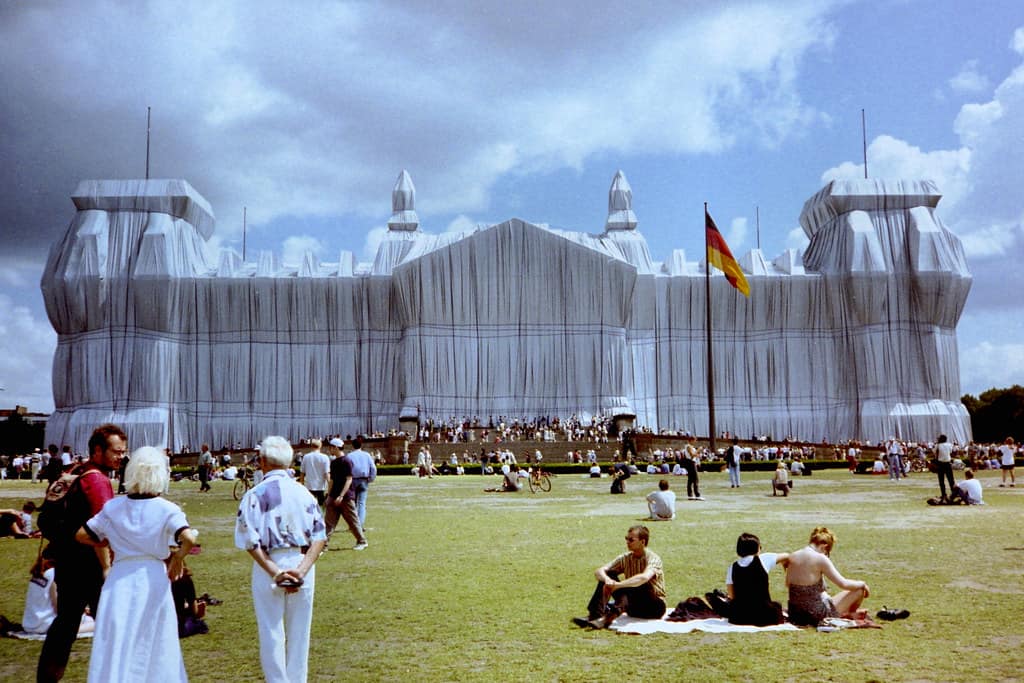
The latter was one of Christo and Jeanne-Claude'south most grandiose undertakings, not only involving 100,000 square metres of silvery cloth, almost ten miles of blueish rope, the labour of around ii hundred professional climbers and installation workers, but also twenty-four years of parliamentary fence. The building was symbolic of tradition and nationalism, but besides problematically associated with the rise of Nazism: it was meant to be wrapped and then unwrapped in an human activity of national renewal. The artists had conceived the idea in 1971 just then had to negotiate with six unlike Chancellors to create a work of stunning complexity, only also fleeting ephemerality since it remained in place for only ii weeks.
Christo and Jeanne-Claude Wrap Upwardly the Reichstag | Lost Art
Only Christo and Jeanne-Claude's work was not all near "wrapping". If a mutual denominator is to be found, it is in the apply of simple objects, fabric, the scenic mediation betwixt nature and homo intervention, and the temporality of these extraordinary transformations.
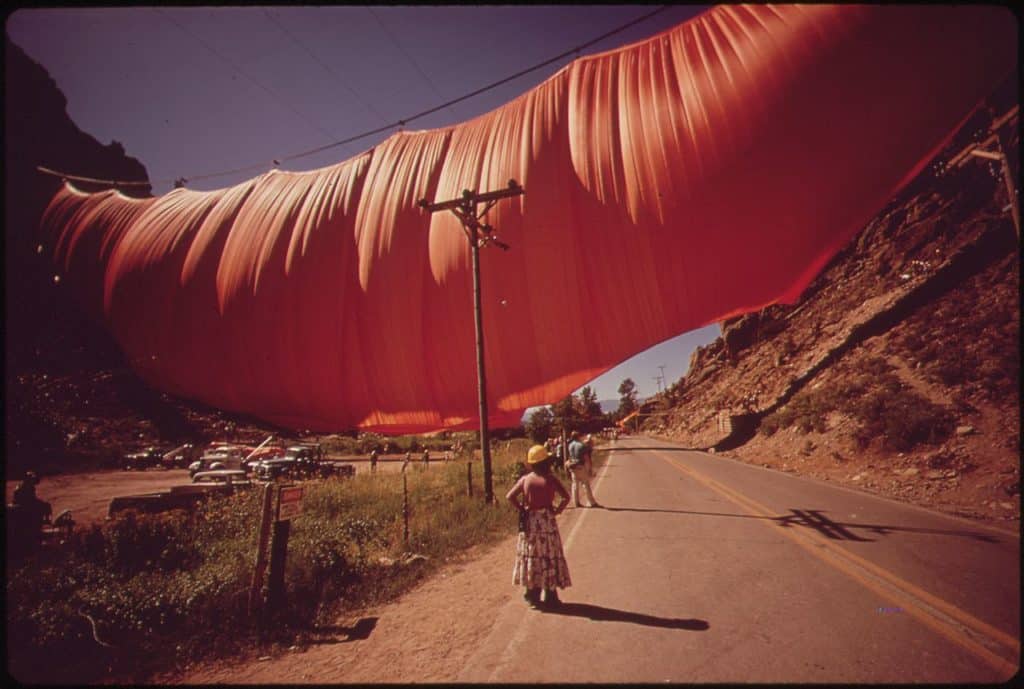
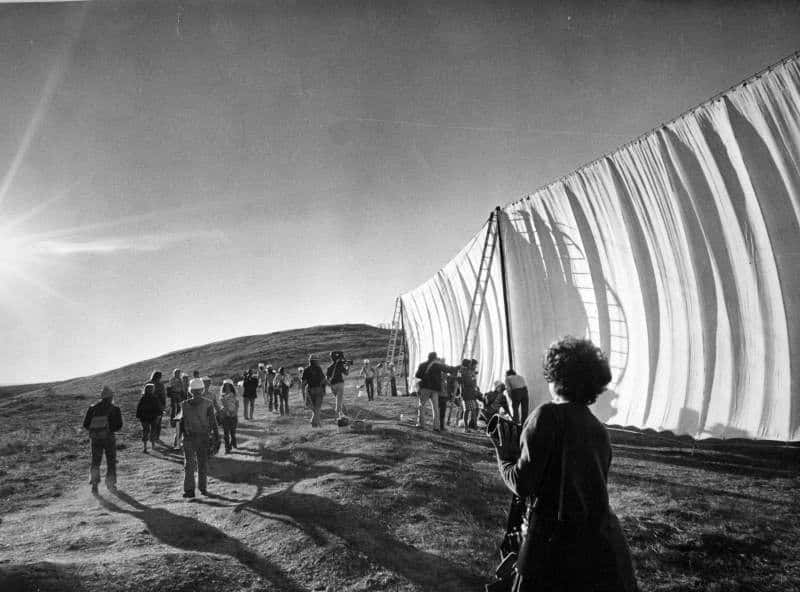
For the projection Valley Curtain (1972), they installed an orangish drape made of woven nylon fabric betwixt two Colorado mountain slopes – the work simply lasted twenty-viii hours since a wind-tempest fabricated information technology necessary to remove information technology. So came Running Fence, a series of white textile panels snaking their way over ranchland in Northern California to the bounding main.
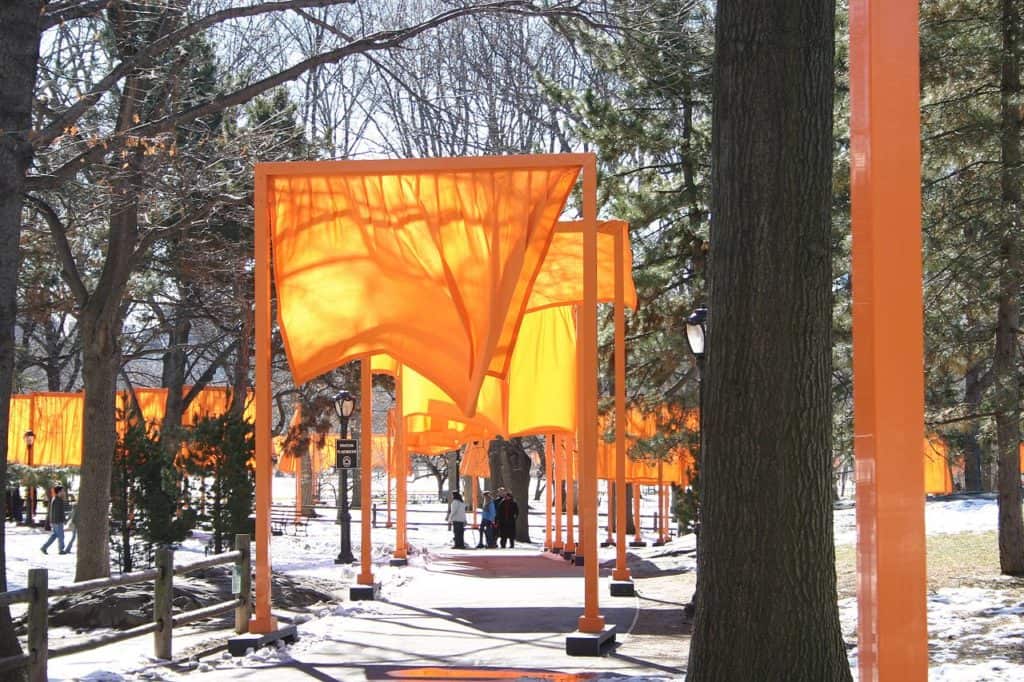
In 2005, they plotted pathways through New York'due south Key Park with thousands of monumental saffron-curtained gates, whilst their last realised piece of work, from 2016, was a shimmering yellowish walkway, floating on the surface of Lake Iseo in Italian republic. Over one million visitors who enjoyed the piece for the sixteen days of its existence could attest to its stunning success, literally walking on water.
Walking on Water - Official Trailer
Conceptual or Land artists?
Christo and Jeanne-Claude have oftentimes been divers equally Conceptual artists or Land artists, though they resisted such categorisations: "Nosotros believe that labels are important, but mostly for bottles of wine". In the old case, they refused the clan claiming that whilst Conceptual Fine art could potentially be without being realised, the essence of their work lay instead in the fulfilment of its physical manifestation, bringing joy and wonder through the accessibility of the fine art, but likewise through the tribulations of the procedure needed to come up to such fruition: "For me, aesthetics is everything involved in the process — the workers, the politics, the negotiations, the construction difficulty, the dealings with hundreds of people (…). That's what I'm interested in, discovering the process. I put myself in dialogue with other people".
In the latter instance, they resisted the 'State Art' definition since they never worked in remote or deserted places, just ever in locations relevant to, and used by, vibrant populations.
Transience was vital to Christo and Jeanne-Claude's creative research, it gave their work the aura of a myth that only impermanence can bestow: "We never let a piece of work be for more two weeks. If you lot don't see it, you don't see it. Nosotros will never make another floating pier, never place another curtain across a coulee – and nosotros will never wrap another parliament".
They often used to declare that their work had no deeper meaning than its imperceptible aesthetics with its but true purpose to create joy, dazzler, and new ways of seeing: "I make things that have no function – except maybe to make pleasure". Nonetheless, a political connotation seemed often to be implied – admitting downplayed past the artists themselves. One only has to return to the beginning of their remarkable sequence and the Wall of Oil Barrels – The Iron Mantle to place this inescapable facet. In 2017, Christo decided to carelessness a long-planned piece of work, Over the River: a proposed almost six miles of silver fabric erected as a awning over the Arkansas River in Colorado for two weeks; information technology would accept been Christo's largest piece of work in America, to be realised at a toll of around $50 million. The reason behind the counterfoil? The terrain's new landlord. Since it was federally endemic, the landlord happened to be the newly elected President Trump, whose administration the artist did non want to have anything to do with: "And here at present, the federal government is our landlord. They own the state. I can't do a project that benefits this landlord. (…) The decision speaks for itself".
A new style to support Fine art: Christo and Jeanne-Claude's business model
The search for freedom that led Christo to escape from his native country as a young man endured across the decades, indissolubly permeating his fine art. In order for their work to attain the desired land of unconditional purity and freedom, Christo and Jeanne-Claude never accepted commissions, grants, scholarships, donations or public money of whatsoever kind, nor any sponsorships or commercial agreements: "We always rent at to the lowest degree 1 km around the site, so no one can apply our work every bit a backdrop for commercial purposes. Information technology has to stay pure". In 1988, they refused a one 1000000 dollar fee for a i minute commercial on Japanese goggle box. They never collaborated with other artists, nor took suggestions or proposals. The duo did non accept royalties either on the books and films about their works, instead they often financially helped – at times entirely funding – the publication of books too as the making of documentaries.
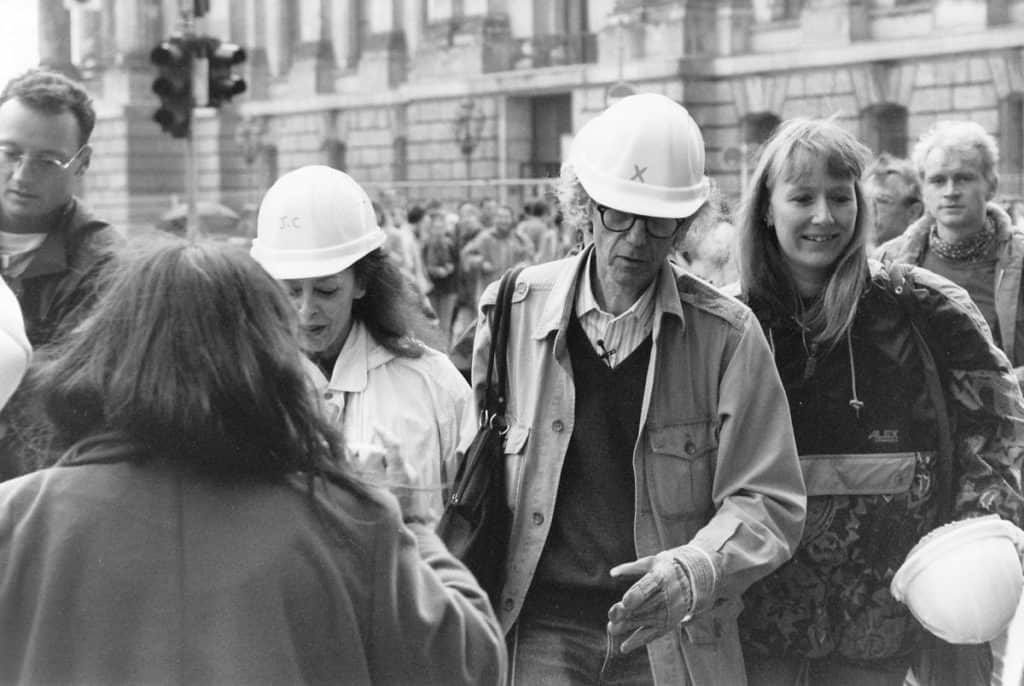
Along with liberty, Christo and Jeanne-Claude greatly valued the democratic aspect of their projects, trying to involve every bit many potential collaborators every bit possible, and across the gamut of man output including engineers, rock-climbers, fabric makers, politicians and many others. Notions of freedom crucially also extended to the liberty of the public to consume and blot their spectacular creations; admission fees were never charged, all of their works had to been enjoyed for costless.
Conspicuously, their projects were non inexpensive to realise. For example, the Wrapped Reichstag in 1995, cost $15.3 million. How was possible to reconcile the largesse of their ideas with the enormous expense of making them? How did they pay for the seemingly countless need for engineers, attorneys, consultants and professional services of all stripes, just also materials, shipping, insurance, rentals and and then forth? Christo and Jeanne-Claude's art may have been itself revolutionary, but no less innovative was their way of operating and funding. They managed to pay for the entirety of each of their projects themselves, latterly by selling valuable early on works from the fifties and sixties, but ever by selling preparatory drawings, collages, and scale models of the very projects themselves. Whilst all works were conceived, ideated and realised by both Christo and Jeanne-Claude, it was only Christo who committed the ideas to paper. These preparatory materials unveil the evolution of their ideas and a clear rendering of vision, cute discrete works unto themselves, simply, equally chiefly a currency to pay the accumulated expenses pertaining to organization, realisation, maintenance, and disassembly of the works.
This unprecedented business organization model assured the couple total freedom and independence: they chose what to do, how to exercise it, and where to do it, bold the co-operation of the relevant authorities as demonstrated by the 24 year hiatus between conception of the Wrapped Reichstag and its ultimate fulfilment.
L'Arc de Triomphe, Wrapped
Years ago, when asked during an interview about retirement Jeanne-Claude said "Artists don't retire. They dice. That's all. When they stop being able to create fine art, they dice". Both she and her husband have lived this proverb, creating until the very end of their respective lives.
However, it is not entirely the case that they take stopped creating fine art: the monumental installation 50'Arc de Triomphe, Wrapped, will be created posthumously next twelvemonth in Paris, in accordance with the wishes of the artist. The project was planned for Fall of 2020 only had been postponed due to the Covid-19 pandemic; information technology volition be in situ for sixteen days starting from the 18th of September 2021 and, information technology goes without saying, will be costless of charge to an enthralled public. Like with all their major public installations it will no doubt allow u.s. see the globe with childlike wonder, and in the process both modify our existing perceptions of the earth that surrounds us, and demonstrate the power the power of patience, perseverance, and relentless determination.
At the same time, a major exhibition will be presented at the Centre Georges Pompidou, devoted to Christo and Jeanne-Claude's years in Paris, ending their story where it began almost sixty years ago.
Relevantsources to learn more than
Christo and Jeanne-Claude Website
List of films and documentaries about Christo and Jeanne-Claude's work
Stories of Iconic Artworks: Christo and Jeanne-Claude'south Surrounded Islands
Source: https://magazine.artland.com/subtracting-reality-revealing-beauty-tribute-christo-jeanne-claude-legacy/
0 Response to "Jeanneclaude Denat De Guillebon Its Only a Work of Art"
Post a Comment