The Adminã¢â‚¬â„¢s Guide to Annual Performance Review Prep
In this guide:
- What is a performance review?
- The purpose of reviews
- The review process
- 360° feedback
- Review questions
- Performance ratings
- Giving meaningful feedback
- Sample phrases & comments
- Addressing common biases
- Performance review software
- Resources
What is a performance review?
A functioning review (aka performance appraisement, operation evaluation, or employee evaluation) is a method to evaluate and certificate an employee's job functioning and behavior in a given period – typically half dozen or twelve months.
Discussing operation in a structured review is a cornerstone of many organizations' employee feedback and evolution processes. Keeping a formal tape of employees' operation can as well be a compliance requirement.
In modern feedback cultures, performance reviews are but one of many events in which recognition and constructive feedback are shared. The almanac or bi-annual review supplements ongoing feedback conversations – like 1:1 meetings – and provides a clear path forward.

The purpose of performance reviews
Lately, the almanac operation appraisement has been met with pushback. With lightweight, real-time feedback available, sitting downward to hash out the past twelvemonth's worth of assignments can feel untimely and unproductive.
But when done right, operation reviews become a fundamental method of employee reflection and refocusing work. Just as formal employee evaluations cannot replace instant feedback on twenty-four hour period-to-day work, continuous feedback alone doesn't let for the holistic reflection that performance reviews facilitate.
For employees
Employees need (and want) to know where they stand and how to improve. As such, Gallup highlighted clarity on expectations equally a cardinal commuter of employee engagement. Operation reviews allow team members and their managers to hold on what's working and what isn't, and align on the best way forward. After half-dozen months or a year of reflection, the content of a formal discussion is spring to be important.
A large movie review too aligns an private's work with larger department goals and the visitor mission. With this in mind, setting goals and clarifying expectations will leave an employee with a fresh mindset on where they stand up and a clear vision for their professional person development.
For companies
Traditionally, performance reviews take been used as a ground for making pay decisions. An evaluation on newspaper, signed and agreed to past both parties, is often used to provide context and justification for any comes side by side. In example of any legal dispute – say, a former employee claims they were fired for reasons unrelated to their functioning – a formal record of an employee's performance may also testify helpful.
More and more companies, however, are using operation reviews primarily as a tool to support their employees' growth and development. In times where retaining and developing talent is a ways to survive as a business, a time-consuming process that only serves an arrangement's compliance needs feels out of identify.
Despite the recent trend of companies ranging from Google to Deloitte ditching functioning reviews, it's important not to fall into the trap of giving upward tried and true practices. Many people know and expect a formal functioning review. Rather than dropping formal feedback, understand why you're giving information technology and maximize its results.
Separating pay and performance reviews
Discussing pay and operation in the same chat can compromise honesty, company culture, and the ability to grow. That's why it's becoming more popular to separate functioning reviews from conversations that lead to pay or promotion decisions.
Past removing pay from performance reviews and beingness explicit about the alternative framework for determining pay, companies tin maintain a pay-for-functioning civilisation without sacrificing opportunities for employee development.
The performance review process
Review processes tend to be overly complicated. People can feel like they spend more time in evaluations than actually driving professional growth or getting piece of work done. Luckily, it doesn't have to be like this.
The employee appraisal should be simple and engaging, and even more so if it'south only 1 of many feedback and coaching opportunities in your performance direction process.
A lightweight performance review process can await like this:
Footstep one: Write downward the feedback
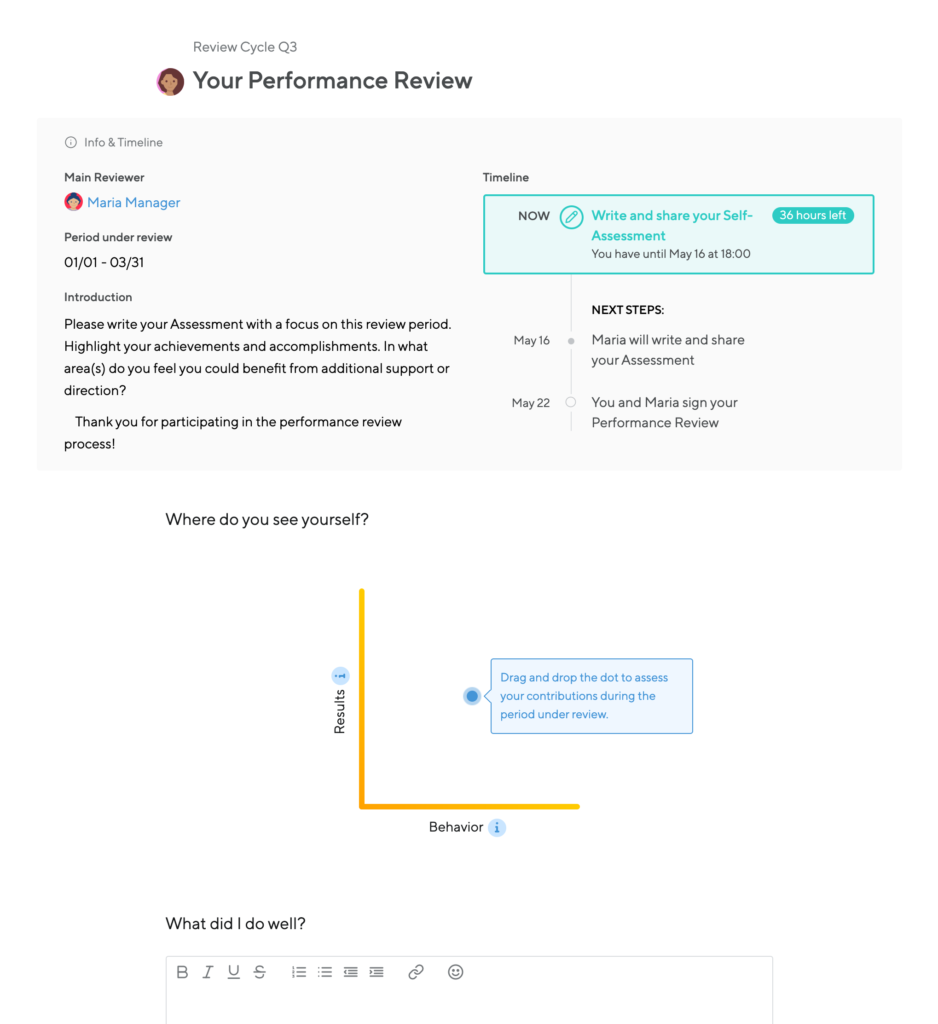
- Self-assessment: the team fellow member reflects on their job performance by answering a set of questions about their contributions and behaviors.
- Manager's cess: the director answers a gear up of questions well-nigh the team member.
Step 2: Discuss the feedback in person
- Performance review meeting: After the employee and the manager take shared their feedback, they meet to hash out it and potentially come up with next steps. (Consider discussing goals or action items in a separate meeting to accept more fourth dimension to let the review sink in.)
Step 3: Sign the performance review
- Managers and squad members adapt the written assessment based on the previous give-and-take (if necessary) and sign the performance review. With signing, both parties ostend that they have completed the procedure, including the in-person conversation.
Simplicity is great, but there are a few things that might exist worth adding to your functioning reviews to heighten their effectiveness.
- Up feedback: The squad member writes up feedback for their director to brand the functioning review a two-way conversation that both parties can learn from.
- 360-caste feedback: The squad member requests feedback from upward to five colleagues that they have frequently worked with to become a more balanced view.
- Calibration: Hour and managers from different teams compare the assessments of their squad members to ensure that feedback is unbiased, fair, and comparable.
360° feedback: a well-rounded review
As the name suggests, 360° feedback (aka 360 reviews or peer reviews) is where an employee receives feedback from multiple angles within an organization. This feedback mechanism combines input from a number of sources - peers, straight reports, managers, self-assessment, or fifty-fifty customers.
Why 360° reviews?
Managers don't see everything. 360° feedback helps avert blind spots and biases influencing the assessment of employee performance. Making 360s part of appraisals allows for employees to exist recognized for their full range of contributions to the organization, beyond the piece of work tasks their reviewer might already be enlightened of.
If you're interested in introducing more regular, multisource feedback into your organization, 360s can be a great place to start. But according to psychologist Kenneth Nowack, poorly designed 360-degree feedback assessments can increase disengagement and contribute to poor operation. Then implementing 360s mindfully is crucial. Through this, companies can diversify feedback and gain rich results without overwhelming their teams.

Tips on implementing 360° feedback
Culture comes first. Having an open up feedback culture tin can assistance employees feel comfortable giving and receiving feedback from peers without mistrust.
Consider these tips when introducing 360° feedback:
- Transparency from start to cease. Be clear on where feedback is coming from and where it will become, specifying what, if anything, will be anonymous.
- Screen the sources. Having the right contributors is crucial for effective 360s. Diverse perspectives are cardinal! Consider having employees nominate their reviewers to discover the well-nigh relevant sources of feedback.
- Curt and sweet. Feedback surveys should be short, clear, and relevant to the recipient'due south chore. Specially when recording multiple responses, existence concise is key.
- Consider using dedicated software. Many companies conduct 360° feedback through online programs. Information technology's easier to facilitate, tally, share, and control anonymity.
Detect our 360° feedback tool
Performance review questionnaire templates
A performance review is made up of questions, so you want to brand sure you're request the right ones. What you ask in your review course is influenced by many factors. The role you're evaluating, your visitor civilisation, and your approach to feedback are just a few of them.
Information technology's worth thinking about what you want to achieve through your review, and whether your questions help you fulfill that purpose. Do you want actionable side by side steps? Do you want people to consider their impact on the business? Do you want to only have a conversation? Here are a few performance review form templates to get you started in the right direction.
The ii-question review
Depending on why your organization uses operation reviews, you might only demand 2 questions. If y'all're looking for a very short and simple mode to start a conversation around performance, ask these questions:
- What did the person do well?
- What could the person improve?
Start, cease, proceed
The beginning, stop, keep method is a popular retrospective design that likewise works for performance reviews. This structure focuses the chat on specific actions that the employee should practice more or less ofttimes.
The operation review questions look like this.
- Executive summary. Begin with a short overall argument about how things take been going during the period nether review. People desire to know how where they stand, and they shouldn't accept to read betwixt the lines.
- Start. What are the things (behaviors, actions, attitudes, projects, tasks, etc...) the person could start doing that would help them brand a bigger impact?
- Terminate. What are the things the person could finish doing that are hindering their growth and affect?
- Continue. What are the things the person should continue doing or double downwards on because they were successful?
Multi-dimensional review
Structuring appraisals effectually multiple dimensions gives managers guidance on what exactly to appraise. Information technology also ensures employees are evaluated against the same criteria which can reduce the impact of biases. The dimensions you use depends and your organization'due south priorities, but we recommend to comprehend both functional and behavioral aspects.
How would you rate [Proper noun]'s functional expertise?
Comments:
How would you lot charge per unit [Proper name]'s power to executdue east?
Comments:
How would you lot rate [Proper noun] on contribution to our concern strategy?
Comments:
How do you rate [Name] on sit-in of company values?
Comments:
Affect review
Operation reviews that seek to evaluate an employee on their overall contribution to the company should apply questions that reverberate this. To assess impact, try using these sample questions as a starting point:
- Start with an executive summary, an overall statement nearly how happy you lot are about the person's bear on on the squad and organisation.
- Reflecting on what the person accomplished, how would you say they impacted the visitor? Consider results, visitor values, competencies, and team goals.
- In your stance, what could that person have washed differently to exist more than impactful? Or what could they do differently in the hereafter?
Performance review ratings
While operation ratings are all the same the standard for evaluating employees, they have come under scrutiny for their lack of insight and failure to help employees grow.
Why do organizations apply ratings in functioning reviews?
Companies need a way to ground pay and promotion decisions, and employees want to know where they stand. For these purposes, ratings can be one style to evaluate employees. Ratings are an easily quantifiable and comparable metric.

Where ratings fall brusque
While ratings may be quick to give, they're oftentimes hard to receive. "Your communication is a 3 on a 5-point scale." And then what? Even if ratings can identify areas for growth, they offer little guidance for the employee to actually grow in these areas. Studies take shown that ratings without guidance tin can exist demotivating, specially for those who get below-average ratings, which in turn hurts functioning.
Ratings have their role in functioning reviews, but they besides have their limitations. And this hasn't gone unnoticed. Thirty large companies, making up 1.5 million employees, accept already phased out ratings co-ordinate to a 2015 study. But nosotros must make certain that, if or when we phase out ratings, we replace them with a more effective feedback system.
How to make ratings meaningful
There are ways to go on ratings in functioning reviews while addressing some of these issues. The primal is integrating feedback alongside the rating.
- More just a number. Statements paired with sliding scales (neutral, agree, strongly agree) or frequency scales (occasionally, frequently, almost always) can offer quantitative feedback without reducing performance to a number.
- Include an caption. Pair ratings with open-text boxes to provide an explanation for your feedback. Some companies accept taken to sharing only the explanation with the employee. This may, all the same, negatively touch on the transparency of the review procedure.
- Place the path to future success. Offer actionable feedback on how the rating could be improved, encouraging employees through a articulate path forrard.
How to give effective feedback in performance reviews
Bersin by Deloitte research establish that in 2018, the highest performing companies had "growth and development" as the master goal of their operation review process. Back in 2006, the superlative priority was still "competitive cess" for 80% of the companies surveyed.
With this tendency of focusing performance reviews on professional evolution, many companies have replaced ratings-based processes with processes focused on qualitative feedback.
Whether or non you keep ratings, information technology'southward crucial that managers know how to requite effective feedback, keeping performance reviews positive and productive. Hither are three tips on giving effective feedback:
- Exist a motorcoach, non a critic. Utilise this time to reinforce what's working and adopt a coaching approach. It's easier for people to take something they're already doing and do more than of it. It'southward harder to exist confronted with shortcomings and try to figure out a way to get better.
- Give feedforward. Rather than referencing a mistake in the past, suggest a solution for the hereafter. This is what feedforward is all about. Instead of letting your coworker know that their presentation was too wordy, give them a suggestion to brand them more than curtailed in future.
- Share your betoken of view. Understand that your feedback is coming from your perspective and frame it appropriately. Be specific near what worked for you lot, when it clicked for you, and what didn't make sense (again, to you). A first-person business relationship can be more insightful than generic statements.
Operation review sample phrases and comments
Functioning reviews should past no means be a copy-and-paste exercise. Comments given have to uniquely and accurately describe the employee'southward performance. But if y'all're looking for inspiration, here are some sample review phrases and comments.
Results
Recognize key accomplishments made by the employee you're reviewing that moved the company forrad.
Sample phrases:
- You exceeded expectations with your work on __________ which resulted in __________ .
- Yous finished the project __________ alee of schedule while still maintaining high quality.
Company Values
Use examples of when the person lived i of your visitor's values in a particularly impactful way. Making comments nearly value-related behavior is of import in every organization that cares most culture.
Sample phrases:
- Information technology was articulate that you lot demonstrate the company value __________ when you lot did __________ .
- You contribute positively to our visitor culture by regularly __________ , a behavior that is in line with our visitor value of __________ .
Visitor goals
Retrieve about how this person'southward efforts contribute to larger company goals. This automatically makes their achievements experience more meaningful and connected to the bigger picture.
Sample phrases:
- Your successful completion of the project __________ significantly contributed to the company goal of __________ .
- It was particularly impactful when you took the initiative to go beyond your assigned tasks and __________ , which contributed to the visitor goal __________ .
Competencies
Highlight individual strengths that had a positive bear upon on the company. This can help the squad fellow member capitalize on their strengths or place blind spots.
Sample phrases:
- In our team, you stand out for excelling at __________ , which has led to __________ .
- You have grown noticeably at __________ , a competency that helped you reach __________ .
Reducing bias in performance reviews
Striving for fairness and objectivity is cardinal in functioning reviews. Unfortunately, everyone has biases, and that includes managers.
Addressing unconscious bias is the first step to help yous foster diversity and inclusion. Hither'south a list of common biases, and how you tin reduce their result on your operation reviews.
Recency bias
Managers tend to focus on the most recent events and overlook events that happened earlier in the time period, which can hibernate of import achievements and growth.
Try this: Use ane:1 meetings and other ongoing feedback mechanisms throughout the year, keeping a solid record that y'all tin refer back to when writing your review.
Halo/horns effect
A unmarried positive or negative impression of an employee tin can influence the way managers view their overall functioning. If a director is particularly impressed by an employee's performance in one case, the director may view that employee with a "halo" and assume that they also excel at unrelated tasks. The opposite effect occurs when a manager sees an employee struggle in one expanse and views them with "horns" and incompetence in other aspects of their job.
Endeavour this: Evaluate performance in several divers aspects of work and have specific examples of behavior to support praise or critique.
Leniency/strictness bias
Managers who are inclined to requite overly positive feedback leave employees unclear virtually how to improve, while highly negative managers can demotivate their team.
Attempt this: Practice yous tend to call up of your squad at a particular end of the traditional rating calibration? Re-eye your calibration with a range of terms above and below your "go-to" rating.
Centrality bias
Some managers are reluctant to rate at extremes. So they tend to put reports in the eye of the rating scale, leaving them without a articulate takeaway of their strengths and weaknesses.
Endeavor this: Even-number scales make a eye-rating literally incommunicable, just focusing on qualitative feedback instead of ratings is likely to be a more meaningful approach.
Confirmation bias
Managers can fall into the trap of finding new information that reaffirms their preexisting beliefs most an employees' performance rather than truly examining all of the information.
Attempt this: Seek out feedback from others through a 360 feedback round, and pay special attending to anything that challenges your cess.
Expedience bias
When addressing a topic in a operation review, a manager can leap to the well-nigh obvious conclusion about what is of import, as opposed to the less obvious simply potentially more than relevant ones.
Try this: Accept team members share a self-review in advance to highlight key contributions that aren't at the forefront of the managers' mind.
Gender bias
Performance feedback given to women tends to reflect their workplace demeanor or attitudes, while men are more likely to receive feedback on by projects and accomplishments.
Endeavour this: Programme to assess all employees on the same predetermined categories to avoid this unintentional disparity.
Similarity bias
People are drawn to others who are similar to them, whether it exist similarities in personality, behavior, skills, or background. When managers are more inclined to positively appraise employees they relate to, this can leave little room for squad diversity.
Attempt this: Review the criteria on which they are evaluating employees earlier entering a functioning review.
The less structured a performance review is, the more than room there will exist for bias. Maintain consistency by outlining topics and criteria on which to appraise every employee. Go feedback from multiple sources and really pay attention, specially if it goes against your initial perceptions.
Employees can simply control their performance, not the bias in their review. It's up to managers to recognize and actively fight their biases, and for 60 minutes to equip them with the knowledge and skills to exercise so.
Performance review software
Despite "paper-based" review forms now more ordinarily being created in spreadsheets or word processors, many organizations are opting instead to manage their operation appraisal through defended software.
The pitfalls of paper-based reviews
Hither are some of the reasons why organizations are abandoning paper-based reviews:
- Paper-based systems take a long fourth dimension for Hour to set and administer, and are every bit tiresome for employees to complete equally they trawl through files to gather testify for their review.
- Filling out clunky word-processed forms can disengage employees, lowering the quality of feedback people offer in the review.
- Analysis of newspaper-based reviews can be hard – inputting and cleaning data can take time, delaying actions from review findings.
These three main issues have driven an increasing number of organizations to seek out operation review software. These tools aim to automate aspects of the review process while improving the quality of reviews and offering simpler data assay.
How performance review software can help
Cadre features of performance review software often include are:
- Automated nudging and email reminders to increase completion rates.
- Functioning review form builders to make information technology piece of cake for HR to build different questionnaires for unlike teams.
- A unmarried source of information to collate feedback given throughout the year, and to set goals and rail progress. This information is then readily available as people complete reviews.
- Integrations with workplace productivity and communication tools to embed performance management into employees' daily routines.
- Analytics and reporting offering quick admission to reports and clean information exports.
Withal with then many performance review tools on offer, it tin can be hard to pick the right one for your organization. Our advice: recollect almost what you want to achieve first, and and then choose the tool that is most likely to aid you fulfill those goals.
Your organization is medium-sized, focuses on employee growth, and wants to combine the performance review with ongoing feedback mechanisms like ane:1 meetings and praise? Then have a look at our operation review tool or request a personal demo.
Resources
Designing a functioning direction process that suits your organization is hard. This toolkit is here to help! In add-on to a comprehensive guide, it includes a design worksheet and a planning agenda to put your new knowledge into action.
Healthy workplace relationships are crucial to a happier, more engaged workforce. In this guide, employee engagement expert Jason Lauritsen shares how to make goal-tracking, performance reviews, 360° feedback, 1:ane meetings, and ongoing feedback more human-friendly.
In this episode of HBR's advice podcast, Honey HBR:, cohosts Alison Beard and Dan McGinn answer listeners' questions with the assist of organizational psychologist Adam Grant. They talk through how to handle reviews that transport mixed signals, are extremely critical, or don't provide enough helpful feedback.
Become workplace tips and resource delivered to your inbox
We collect, use, and process your data co-ordinate to our Privacy Policy.
Source: https://www.small-improvements.com/resources/performance-reviews/
0 Response to "The Adminã¢â‚¬â„¢s Guide to Annual Performance Review Prep"
Post a Comment